University of Florida Institute of Food and Agricultural Sciences
logo - University of Florida's Institute of Food and Agricultural Sciences
MENU
  • HOME
  • About
  • Pest Snails ID Tool
    • Amber Snails
    • Ghost or Peanut Snail
    • Rosy Wolf Snail
  • Events
  • Search

Snail Pests Identification

Snail Pests Identification

  • programs.ifas.ufl.edu
  • Snail Pests Identification
  • Pest Snails ID Tool
  • Amber Snails

Amber Snails

Scientific name: Succinea spp.

Common name: amber snails

Author: Kathi Malfa, Xavier Martini, Francisco Borrero.

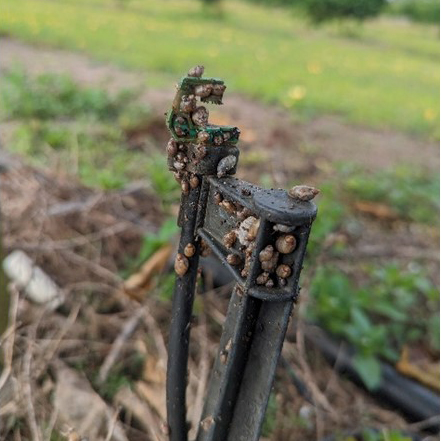
The Succinea snails are a genus of terrestrial snails with several species native to Florida and the southeastern United States. The snails tend to aggregate near moisture and plant matter; thus, they have been observed in crops and irrigation systems. Like many other species of terrestrial snails, they are likely hermaphrodites with each individual containing male and female reproductive organs. This means that under the correct conditions, these snails can potentially overwhelm plants or irrigation systems. The snails typically consume detritus and plant films, and thus, they generally are not directly harmful to plants. These small snails are tan to amber in coloration, some semi-transparent, and approximately 1 to 2 cm in length. Their shells contain 2 to 3 whorls with a distinctive shape in which the whorls taper toward the posterior right side of the shell instead of tapering uniformly down the midline.
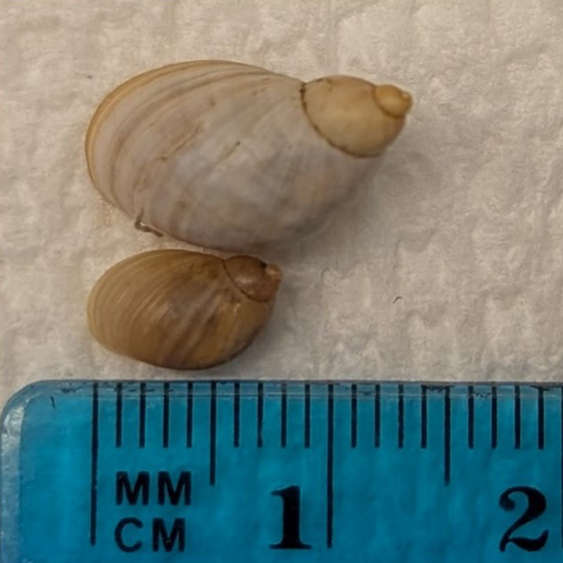
The Succinea snails are a genus of terrestrial snails with several species native to the southeastern United States.

Figure 1. Succineidea adult and juvenile.
Figure 2. Commonly observed moisture aggregation and climbing behavior
Figure 2. Commonly observed moisture aggregation and climbing behavior.

Differentiate B. bonariensis from Succinea snails:

In Florida, succinate snails are often found in mixed populations with the invasive B. bonariensis. However, succinate snails tend to be less damaging and are controlled by natural enemies. This is how to differentiate B. bonariensis from Succinea snails:

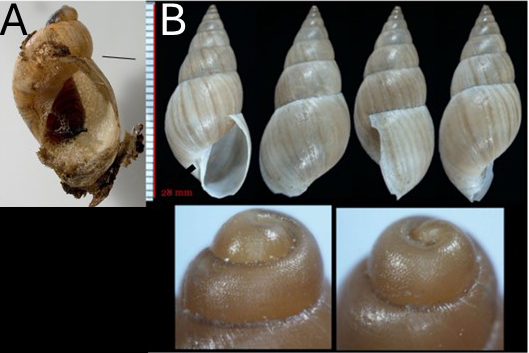
In the Succinea, the spire, which comprises all whorls up to the apex of the shell, consists of only 2-3 whorls. Therefore, the shell’s aperture occupies the great majority of the total length of the shell, from the basis to the apex. In B. bonariensis, the spire consists of several more whorls (5 to 7) than in the Succinea, such that the aperture occupies a much smaller proportion of the total length of the shell (Fig. 3).


Figure 3 Succinea shell parasitized with a Sarcophagidae fly
Fig. 3: (A) Succinea shell parasitized with a Sarcophagidae fly. Note that the aperture occupies most of the shell’s length, whereas in B. bonariensis (B), the aperture is reduced as compared to the total length of the shell. Succinea spire only has 2-3 whorls, whereas B. bonariensis has 5 to 7 whorls
University of Florida Logo
Contact

Feedback
Snail Pests Identification
155 Research Rd, Quincy Fl. 32351
850-875-7160

Land Grant Mission
  • Teaching
  • Research
  • Extension
Information
  • Ask IFAS (EDIS)
  • UF/IFAS Experts
  • UF/IFAS Blogs
  • UF/IFAS Bookstore
Policy
  • Accessible UF
  • EEO Statement
  • IFAS Web Policy
  • SSN & UF Privacy
  • Analytics (Google Privacy)

© 2025 University of Florida, IFAS Last Modified:Mon, 18 Aug 2025 12:07:43 EDT