UF Institute of Food and Agricultural Sciences logo
Give      University of Florida
Resources
    Toggle Search Form
    GIVE UNIVERSITY OF FLORIDA
    • HOME
    • About
    • Team
    • Activities
    • Resources
    • Volunteer

    Nextgen AgTech Innovators

    Nextgen AgTech Innovators

    wires are plugged into a circuit board. a monitor is in a bowl of water to collect data for a research project.

    Learn More

    • Mission and Vision
    • Technology Areas
    • Agricultural Priority Challenges
    • Instructional Model

    NextGen AgTech Innovators

    Shaping the Future of Agriculture Through Youth Innovation

    The NextGen AgTech Innovators initiative is a youth-focused educational program led by the University of Florida’s Institute of Food and Agricultural Sciences (UF/IFAS).  The program is designed to prepare the next generation of agricultural leaders by engaging youth in hands-on learning experiences that integrate emerging technologies with real-world agricultural challenges.

    Developed in collaboration with Florida 4-H and the NSF Engineering Research Center—Internet of Things for Precision Agriculture (IoT4Ag), the program introduces youth to the emerging technologies transforming modern agriculture, including Artificial Intelligence (AI), Robotics, Data Science, and the Internet of Things (IoT).

    Students assembling a project during a NextGen AgTech Innovators hands-on workshop.

    NextGen AgTech Innovators program engages students in authentic agricultural challenges and promotes experiential learning through hands-on workshops, statewide virtual clubs, and structured problem-solving activities. By integrating the strengths of UF/IFAS research, extension, and teaching, the program connects youth with interdisciplinary expertise in plant science, engineering, agricultural education, and digital technology.

    Designed for learners aged 13-18, the NextGen AgTech Innovators program emphasizes real-world application, critical thinking, creativity, and collaboration. Through guided instruction and research-connected educational experiences, the initiative builds foundational STEM and AgTech competencies that prepare youth to lead and innovate in sustainable agriculture and related fields.

    Mission and Vision

    Mission

    NextGen AgTech Innovators program mission is to deliver engaging, research-connected, and technology-driven learning experiences that inspire youth to explore STEM and AgTech pathways. Through workshops, SPIN clubs, STEM clubs, hands-on modules, digital learning tools, and community partnerships, we strive to:

    • Inspire curiosity in agriculture and technology
    • Instruct through structured, problem-based learning
    • Equip youth with tools, digital skills, and meaningful mentorship
    • Empower students to innovate, lead, and contribute to sustainable solutions within their communities

    Vision

    NextGen AgTech Innovators program envisions a world where young people - regardless of background or location - have the knowledge, tools, and confidence to lead the future of agriculture, sustainability, and technology. We aim to create a thriving ecosystem of youth innovators who are prepared to tackle global challenges with creativity, leadership, and purpose.

    The NextGen AgTech Innovators program introduces students to a diverse set of technology domains that are reshaping modern agriculture. These areas help youth understand how digital tools and automation contribute to smarter, more efficient, and more sustainable agricultural systems.

    “Graphic showing six technology focus areas: Robotics and Automation, Sensors and Instrumentation, Energy and Sustainability, Internet of Things, GPS and Geospatial Technology, and Design Thinking and Prototyping

    Image created using an AI-based design tool. No copyrighted source material was intentionally reproduced

    These areas support hands-on exploration and reinforce STEM concepts through real-world agricultural applications.

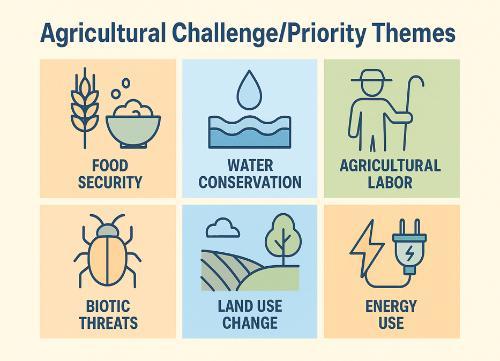
    NextGen AgTech Innovators introduces youth to key challenges faced in agriculture today and encourages them to design technology-based solutions. These challenges reflect current industry needs and UF/IFAS research priorities.

    Graphic showing six agricultural challenge priority themes: Food Security, Water Conservation, Agricultural Labor, Biotic Threats, Land Use Change, and Energy Use

    Image created using an AI-based design tool. No copyrighted source material was intentionally reproduced

    Through activities and projects, youth learn how technology can address these challenges in practical, impactful ways.

    The NextGen AgTech Innovators program uses the ADDIE instructional design model - Analyze, Design, Develop, Implement, Evaluate - to ensure that all learning experiences are well-structured, effective, and adaptable.

    • Analyze: Identify learning needs, youth interests, and agricultural problems. Engage stakeholders, youth representatives, and partners to guide program direction.
    • Design: Plan instructional strategies, create learning goals, and outline activities that connect STEM concepts with real agricultural applications.
    • Develop: Create hands-on modules, teaching materials, digital resources, and project kits that support both in-person and virtual learning environments.
    • Implement: Deliver workshops, virtual club sessions, and hands-on activities guided by UF/IFAS educators, mentors, and 4-H leaders.
    • Evaluate: Use feedback, assessments, and youth input to refine modules and improve instructional effectiveness over time.

    The ADDIE model ensures continuous improvement and supports the creation of high-quality, research-informed resources for youth and educators statewide.

    University of Florida Logo
    Contact

    Feedback
    Nextgen AgTech Innovators
    155 Research Rd, Quincy FL 32351
    nextgenagtech@ifas.ufl.edu

    Land Grant Mission
    • Teaching
    • Research
    • Extension
    Information
    • Ask IFAS (EDIS)
    • UF/IFAS Experts
    • UF/IFAS Blogs
    • UF/IFAS Bookstore
    Policy
    • Accessible UF
    • EEO Statement
    • IFAS Web Policy
    • SSN & UF Privacy
    • Analytics (Google Privacy)

    © 2025 University of Florida, IFAS Last Modified:Thu, 29 Jan 2026 14:58:25 EST